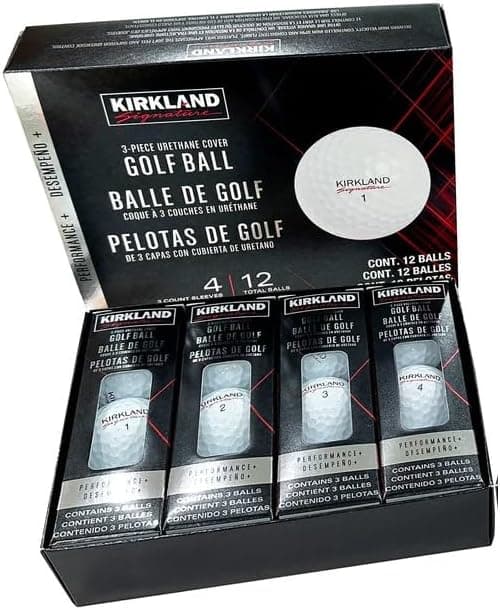
If you have spent any time around a golf course over the last few years, you have undoubtedly heard the whispers, the rumors, and the outright evangelism surrounding the Kirkland Signature golf balls. Costco, the undisputed heavyweight champion of bulk paper towels and rotisserie chickens, seemingly overnight disrupted the traditional golf equipment market. The result? The highly anticipated Kirkland Signature Three-Piece Golf Ball.
At a staggeringly low price point of around $29.60 per pack, this ball promises tour-level performance without the premium tour-level price tag. But does it actually deliver on the course, or is it just another budget ball masquerading as a premium offering? At BirdieFinder.Golf, we took this fan-favorite to the fairways to find out.
Key Features & Technology
When evaluating a golf ball in this price tier, you usually expect a two-piece distance ball with a hard Surlyn cover. The Kirkland Signature flips that script entirely, offering a sophisticated three-piece construction that rivals balls twice its price.
Highly Elastic Rubber Core
The engine of the Kirkland Signature is its highly elastic rubber core. This core is designed to maximize energy transfer upon impact. For a player with average to above-average swing speeds, this translates directly into raw ball speed and, consequently, impressive distance off the tee.
"Speed Boost" Mantle Layer
Sitting between the core and the cover is the "Speed Boost" mantle layer. In a multi-layer urethane ball, the mantle is critical. It acts as a transitional layer that helps regulate spin. Off the tee, it works with the core to keep driver spin manageable. On approach shots, it provides a firm backstop for the softer cover to compress against, generating the necessary backspin to hold firm greens.
Cast Urethane Cover
This is the holy grail feature. Most budget balls use an ionomer or Surlyn cover, which is durable but feels like a rock and rolls out infinitely on the green. The Kirkland Signature features a cast urethane cover—the exact same premium material found on the Titleist Pro V1, TaylorMade TP5, and Callaway Chrome Soft. Urethane allows the grooves of your wedges to bite into the ball, generating massive amounts of greenside spin and delicate control.
338-Dimple Design
Aerodynamics play a massive role in how a golf ball performs in the elements. The 338-dimple pattern on this ball is specifically engineered to reduce drag. During our testing, the ball maintained a penetrating, consistent flight, resisting ballooning even into stiff headwinds.
Performance on the Course
Tech specs are great on paper, but a golf ball proves its worth in the dirt. Here is how the Kirkland Signature Three-Piece performed during our rigorous on-course testing.
Distance
Off the tee, the Kirkland Signature is undeniably long. The highly elastic core does its job admirably. When paired with a modern, high-forgiveness driver like the TaylorMade Golf SIM2 MAX Driver, the ball absolutely leaps off the face. However, it is worth noting that some high-speed swingers might notice a marginal increase in driver spin compared to ultra-low spin premium balls. If you struggle with a slice, that extra backspin and side-spin might be slightly exaggerated, but for the vast majority of amateur golfers, the distance is right up there with the top tier.
Forgiveness and Wind Performance
Forgiveness in a golf ball generally relates to its aerodynamic stability and how it reacts on mishits. Thanks to the 338-dimple design, the Kirkland Signature fights through the wind exceptionally well. It delivers a medium-to-low trajectory that pierces through gusts rather than riding them. The urethane cover also provides exceptional durability; while early iterations of Kirkland balls had issues with scuffing, this modern three-piece variant holds up surprisingly well after full wedge shots or an unfortunate encounter with a cart path.
Feel and Sound
Compression is a vital metric for feel. The Kirkland Signature measures at approximately 93 compression. To put that in perspective, a standard Titleist Pro V1 sits around an 87 compression. Because the Kirkland is slightly firmer, it provides a very distinct "click" on impact.
With irons and wedges, this firmer feel gives excellent feedback. You know immediately whether you have pured it or caught it off the toe. On the putting green, this firmer compression means the ball pops off the face with a slightly sharper sound. If you are using a milled face putter like the Cobra Golf Classic Blade Putter, you will notice a crisp, responsive feel that many traditionalists love, though players who prefer a marshmallow-soft feel might need a brief adjustment period.
Specs at a Glance
| Feature | Specification |
|---|---|
| Construction | 3-Piece |
| Cover Material | Cast Urethane |
| Core | Highly Elastic Rubber |
| Compression | ~93 (Medium-Firm) |
| Dimple Pattern | 338 |
| Target Swing Speed | Medium to Fast |
| Price | $29.60 |
Comparisons and Alternatives
While the Kirkland Signature is an undisputed value king, it is always wise to look at the competition. If you are exploring the market for golf balls that balance price and performance, you should consider your specific needs.
If you are a player who struggles with distance and prefers a softer feel, you might want to look into a two-piece distance ball that utilizes a specialized dimple pattern to keep the ball in the air longer.
Unlike the urethane Kirkland, the Mizuno 2024 RB 566 Golf Balls prioritize massive hangtime and a softer feel, making them a fantastic alternative for players with moderate swing speeds who want to maximize their carry distance.
Additionally, upgrading your golf ball will only get you so far if your equipment is holding you back. If you are loving the penetrating flight of the Kirkland but want maximum distance and forgiveness off the tee, combining it with a top-tier driver is a match made in heaven.
Finally, because the Kirkland produces a firmer click off the putter face, matching it with a putter that provides brilliant feedback can really dial in your distance control on the greens.
Who Should Buy This?
So, who is the ideal candidate for the Kirkland Signature Three-Piece Golf Ball?
- The Budget-Conscious Mid-Handicapper: If you shoot between 80 and 95 and want the greenside spin of a premium urethane ball but refuse to pay over $50 a dozen, this is exactly what you are looking for.
- The High-Volume Golfer: If you play three to four times a week and lose a couple of balls a round, the cost savings here are astronomical over a full season without sacrificing short-game control.
- Players Who Prefer a Firmer Feel: If you like auditory feedback and a ball that clicks off the putter and wedges rather than providing a muted thud, the 93 compression rating is right in your sweet spot.
Conversely, ultra-fast swingers who fight too much spin off the tee might want to look elsewhere, as the mantle and core can occasionally produce a slightly spin-heavy driver flight for those swinging over 105 mph.
Final Verdict
The Kirkland Signature Three-Piece Golf Ball is not just "good for the money." It is simply a good golf ball. Period.
By successfully combining a highly elastic core, a speed-boosting mantle layer, and a genuine cast urethane cover, it delivers performance metrics that closely mirror the most expensive, tour-level balls in golf. While the 93 compression yields a slightly firmer feel and a noticeable click, the trade-off is exceptional greenside spin, penetrating ball flight, and solid durability.
If you have been hesitant to try "store brand" golf balls, it is officially time to put your pride aside. Stock up, tee it high, and watch your scores—and your budget—improve drastically.
BirdieFinder.Golf is a participant in the Amazon Services LLC Associates Program, an affiliate advertising program designed to provide a means for sites to earn advertising fees by advertising and linking to Amazon.com.